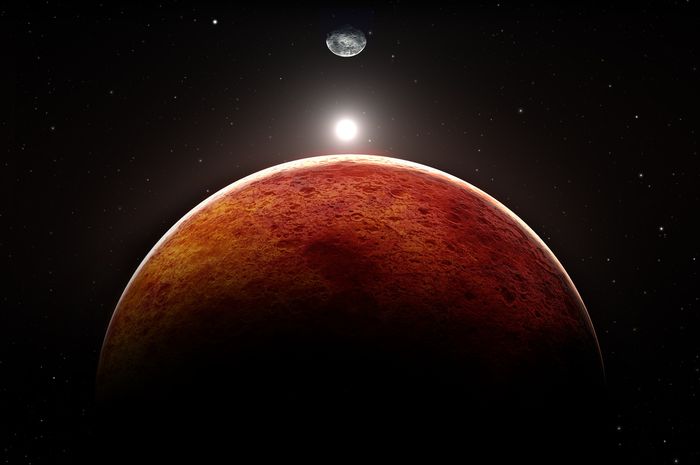
According to a recent study, Mars was once covered by ice like the Arctic, instead of being surrounded by rivers.
When the valleys that cross the surface of Mars are found, it gives the idea that rivers once flowed on the surface of Mars. However, the study states, the liquid on the planet turns out to be from ice that is similar to that in the Arctic.
Furthermore, according to the researchers, this actually benefits aliens who may have lived on ancient Mars. This is because the ice sheet will provide protection, allow the water underneath to remain stable and serve as a barrier to solar radiation.
Also read: Mars Occultation to Meteor Rain, This is a Celestial Phenomenon in August 2020
Scientists research thousands of valleys of Mars so that they get detailed information about the construction of planets. They then compared them to channels found on the Martian surface - helping to understand what conditions triggered their appearance.
The results suggest that the valley network appears to have emerged as a result of the erosion of extensive water flowing under ancient ice sheets.
"Over the past 40 years, since the Martian valleys were discovered, the assumption has arisen is that rivers once flowed there and eroded the existence of the valleys," said Grau Galofre, leader of the study published in Nature Geoscience.
"But there are hundreds of valleys on Mars and they look different from each other. If you look at Earth from a satellite, you will see many valleys: some of them made by rivers, glaciers, and other processes. Each type has a distinctive shape. Likewise with Mars, the valleys look different, showing that a lot of processes were involved to form them, "said Galofre.
Also Read: Hubble Telescope Successfully Captures Saturn Images in More Detail
The study also answers the mystery of how valleys can form on planets so far from the Sun.
"Modeling predicts that the climate of ancient Mars was much cooler during the formation of the valley network," Galofre said.
"We tried to put it all together until we finally came up with a hypothesis that had not been considered: namely, that a network of valleys can form underneath the ice sheet, as part of a drainage system that forms naturally when water collects at the bottom," he concluded.
Comments
Post a Comment