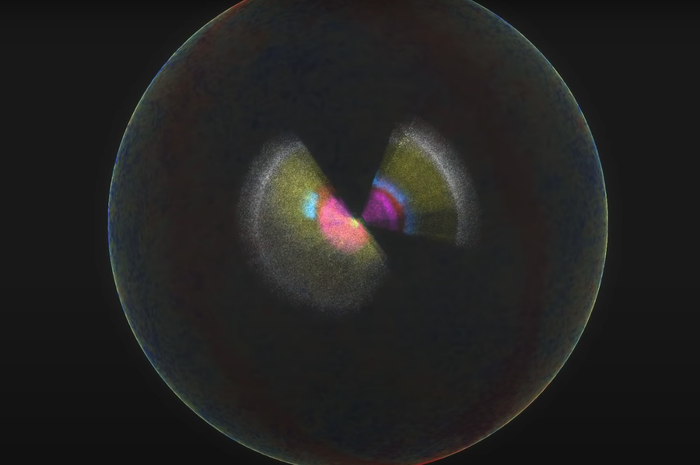
The Sloan Sigital Sky Survey (SDSS) has published an astonishing analysis of the universe. Published in 23 papers, the project, called the Extended Baryon Oscillation Spectroscopic Survey (eBOSS), measured more than two million galaxies and quasars. The end result is the largest three-dimensional map of the universe.
Although previous observations have mapped the closest galaxy to the Milky Way and studied it in the Cosmic Microwave Background (CMB), there are gaps in the data.
“We know the ancient history of the formation of the universe and its final expansion. However, there are gaps in those 11 billion years, ”said Kyle Dawson, lead researcher at the University of Utah.
“For five years, we have worked to fill that void. We use existing information to find out the great advances in cosmology in the last decade, "he added.
Also Read: United Arab Emirates Successfully Launches Its First Mission to Mars
This map is our best understanding of the expansion rate of the universe since the Big Bang. The study results confirm that the expansion of the universe began about six billion years ago and then accelerated afterward. It is thought that the expansion is caused by a substance known as dark energy.
"Taken together, detailed analysis of the eBOSS map and the SDSS experiment has now provided the most accurate historical expansion measurement in the time span of the universe," explains Will Percival, eBOSS Survey Scientist at the University of Waterloo.
"This study allows us to connect all measurements and make a story about the expansion of the universe," he added.
Also Read: How Many Humans Does It Need To Survive on Mars?
Astrophysicists have known for years that the universe is expanding, but have been unable to measure its expansion rate with precision.
Comparison of the eBOSS observations with previous studies of the early universe has revealed differences in the rate of expansion.
The currently accepted rate - called the "Hubble constant" - is known to be 10 percent slower than the value calculated from the distance between our closest galaxies.
Comments
Post a Comment