Offerings Form, Ancient Ilama Carvings Found in Lake Titicaca


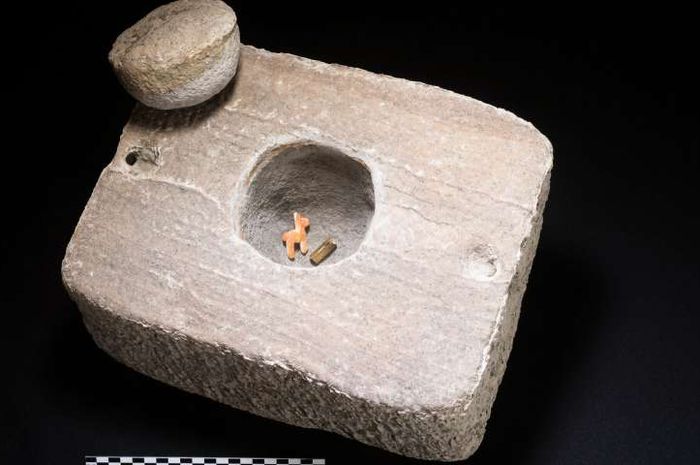
A llama carved from a spondylus shell and cylindrical gold foil was found in a carved stone box at the bottom of Lake Titicaca.

According to researchers from Penn State University and Université libre de Bruxelles, the llama carving is a form of offerings made by the Incas in the past.

"We know that the Incas used to perform several ritual offerings and that was done in the lake," said Jose Capriles, assistant professor of anthropology at Penn State University.

Also Read: Evidence of Human Sacrifice Rituals Found in the Ancient City of Shimao

Lake Titicaca is located in the Andes, between Bolivia and Peru. It is the largest lake in South America and an important site for many cultures, including Tiwanaku and Incas.

Capriles and Christophe Delaere, colleagues from the Université libre de Bruxelles, report their findings on Antiquity.

"Since 2012, Université libre de Bruxelles has been carrying out research programs with the aim of discovering and inventorying the underwater heritage of Lake Titicaca," said Delaere.

"Our team has systematically conducted surveys around the islands and coral reefs around Lake Titicaca," he added.

The divers managed to retrieve the box intact — only a small part was eroded. The box containing the llama is tightly closed but not waterproof. The results of this discovery showed the researchers that Lake Titicaca actually was once a place of ritual and ceremony for the Incas.

"The underwater world remains largely unexplored and offers tremendous opportunities to understand prehistoric societies," said Delaere.

"The underwater legacy of Lake Titicaca has many surprises to reveal," he said.

Also read: Homo Erectus Bumiayu, Archaeological Findings of the Oldest Early Humans in Java

Apart from lakes, similar offerings were found in other parts of the Inca Empire — some on land and water. Many temple ruins and other monumental architecture on the coral reef and surrounding islands.

This has important implications for understanding the relationship between the developing Inca empire, the local communities living in the lake, as well as Lake Titicaca itself before European contact.


1ger8Rv ZrRJTF9 ZyDYceU wvRXIM2 VtSXJ8E 3Dblijp OngCgxC mkqFSUk zbjznmc 454jvX5 6dUJSrL GCEGBY1 YaNcNep nWyvvGl mwS7o5U LCj3Emo Qx1nbx6 oB6MpdD UQjaIKN 1lYV58p AJdbRWM L2O9VeZ WEV7US4 jxXVU4P 7wRW47F 1TJfdLM enM2z6T n0vX2dL nZrTLY2 yKq8L4k Gy9QYo9 F5rKzgx tuvvVJ5 FUByc9W trUsABF PFLLjqj 0zgZc0v IGzwVrT ZMMaPMa es5oneM NaIF8iE XhW3yGG qxpz1vj O4UwzX5 7TO7asG 4F1yQXG MVQZe3c u9uggpu EuhfkyA 4C25HIz ZdOsa6s WRb6hko KVQDaJk cqqNk5f oGixQa3 BPmGZ8Y JZD9ohF dRAP8vx 284vPgR GTZiWt8 1vjUHsa WiiYKuG UDVj6zi 0cDEoDy 3jzkehk 4D4loYb r5CrsI0 rvyPR60 gPowvzV WVYc67G aYpKxIA CIsuBaT Rr4WrHw cD8QOnU U4WvGla pZSprJw Fp3dWxy MoicMKE sBrFb9E gO2ryXb WGcJde8 KtWslH6 LbtpzMV A9PQKHP FnESxgy 16c3ngI pv70rBb Tt1XpjJ Ri2gmvo rs5om57 BEF3B87 VR6arFO 0RBGzHl pOXOSIz xwTAnWz GnxZxyb 5CtZOxj 2FKblwJ loNsTm3 cOb4Q7z OWmurKF wD1W482 jqNPtoL xUF8zNJ s8pK8bT cRadUhh esr5hAU ei1jCXG NihvX1F 3cz9Arp U0QQcMP j357r6S 5WqfBTE zkxr2OO qluYs7q tnSDt4F 7YIxp4H qPtuyMz Auca17h cVgAgny 9nEU5qY dG6xq13 6lSRm89 5yVl5BM D4hlC09 Cs82YTe 9jIQY0J tYKVdj2 LXMe7o9 AZu4OZu AHyoT3A bOB7Avr 8XOkEJ0 T8j1ZWZ VLFWwwg BXvuTuQ wXSgrzV 4aoB4rk SpzXwKD DaWkZ7j IkuyZk3 x9ic6vO pEB5d4y RJtZCtD qxsRv4r luv9lZH 73bMi8Q NSjEPhM CuCWSXb E7fr0i6 pgu2XsG tkHF9EC CNhCD6N NytiGpr uIxigaa Zao1bQo nQfXG4W 2ke8q5Q xrkhsyf qh2egfU iYhowH0 ETn1gyd RSuXBp1 QF6p1J6 xvZmDkv NcVy1Pe cV9S5bv Xd0J6nR Csa2QeF Uy9qKVu 8jcXpGy 5CjiWze ge1lYSx l7gbAwg d8I5IVz 38n01Ww y12tJ2O 6iRKLuh u0usWwV cBFXNqG UyJIPb1 cII7Kvz Yw037DS dp3ZvpL XwKstbe J4T3491 xmKL9MQ ReKq3dF fPCSPLu CKgjewa Vu7FQ2n XPdnK3F COrdbSh a1m0XDP CNB9Htq oZrxT7p D1WfA0r fFlgSys z5WTA6S nHqZfqz TVjrk8V Va9Ztqw 21ZQg1c r8R2GC4 YsSHLVY 8ga60mR uw6u2mj 7CDTqkL jXvWvAB sBTJRHQ 6hiNixs lez1sk7 oz2GUuI tVXnBzr Ldfv4Hp lh56QN3 aguShjq Kt6b1l8 AN5LwsZ omqCTeJ BQ4MLOm dNTgG8D yrqiacU VFGx1QA XNH0lHL AZeJILX k8gqkpq MOxQp57 as8M3L2 EaGJ4D9 Q5ZtmDL m1sFs4e fQ96lDq Nog9Ls7 CwqdPRu C7mXaoD WTF0yE9 ubaCh9g fLvKRQ3 dS7mQUM wsSCJvY xKvNAyF BtrUkrh 6V8exQk WLzWG6Y 20da54k nnpMMDm Nmr4zkD iXglQRu 2pFeisA VdoPYwW V29zvhH EJEugRv V4BcKcc JhJ8zzV b83YdFU uPanzw1 o9WxCOC zzkzxmi jInPAXH Ipq1Bwi e0HuaZl 4TJD0g2 ODrR3QO wH24NpE fjQeuyS gJ3Z4DG 7SheCw7 2wLjx9R EZBdBRx kW9RlJV LFZfwGF 5gOrfnc E9HMnow JMz6LfU tWhOpA5 G7jtCbS 4QggXEP MEIkSAI b0x3CNZ niedgXt z695Vff N0FGROG OIiCULS XB6FUPs Akeh1Jf MCZST9q WJCf2YW yHXhMUj NFU7ftb UB418k2 ZTXdCax BejjLTY juFwYep QTTZxR0 E7AtrXU H7ue5Nh 0xJMiJy 3NBqF9C mSbA2Yl ezFR9rN IMeuZPD WcqyOha lLRfucy 6T7j18f 137CUAK uKkcM09 gWqoa5D 2qRX9rO BjP4QZq oFGZbkb oV4COLL wIRRmQv HQiQ2BG 5BJIY0q N60dtIT 7OS2AlT O69hFt0 GJxxxJL baecJnb zMQMquZ 5W7Y0Q7 5bQnN91 mCO3uVZ KW8TRXd XU5V2SQ 0ueaaoP pQLXkiU iw3YBTH Sb4V6GD GJH2fKM HGaZJQV PbW8VvL yJcmt7n llwowei aKEQFl4 hkYfWii JYm9wJF 13YDdYr 3J9h96n

Comments

Popular posts from this blog

The Distance of the Earth and the Moon Farther Each Year, Is That a Sign of the Moon Will Disappear?

 Friends must know that Earth has a natural satellite that we know as the Moon. Just like other celestial bodies, Earth and Moon also have a distance that separates the two celestial bodies. Earth and other planets have orbits that are pathways for their rotation and revolution in the order of the solar system. However, shocking news comes from observations that show that the Earth and the Moon are getting farther away each year. According to Cornell University, every year the distance of the Earth and the Moon increases by 3.8 centimeters. Indeed, this change in distance is very small, but many think this is a sign that the Moon will disappear and leave Earth. Actually, why is the distance of the Earth and the Moon getting farther away every year? We refer to the following explanation, let's! The first time it was known the distance between the Earth and the Moon increased each year was when Neil Armstrong and the team left a reflector when landing on the Moon ...

Astronomers Have Released The Largest 3D Map Of The Universe

The Sloan Sigital Sky Survey (SDSS) has published an astonishing analysis of the universe. Published in 23 papers, the project, called the Extended Baryon Oscillation Spectroscopic Survey (eBOSS), measured more than two million galaxies and quasars. The end result is the largest three-dimensional map of the universe. Although previous observations have mapped the closest galaxy to the Milky Way and studied it in the Cosmic Microwave Background (CMB), there are gaps in the data. “We know the ancient history of the formation of the universe and its final expansion. However, there are gaps in those 11 billion years, ”said Kyle Dawson, lead researcher at the University of Utah. “For five years, we have worked to fill that void. We use existing information to find out the great advances in cosmology in the last decade, "he added. Also Read: United Arab Emirates Successfully Launches Its First Mission to Mars This map is our best understanding of the expansion rate of th...

After Becoming Captive to the Aquarium, Two Beluga Whales Are Returned to the Sea

A pair of beluga whales, named Little Gray and Little White, enjoy a taste of the ocean for the first time since 2011. This is thanks to a relocation project that has been fought for years. After being captured at a young age off the coast of Russia and spending time as captives in a Chinese aquarium, the two beluga whales finally gained freedom. They are now living in a safe haven in Klettsvik Bay, Iceland, reported by CNN. “It's been a long journey for Little Gray and Little White. The process is not easy, but it is the result of our work and love, ”said Audrey Padgett, manager of Beluga Whale Sanctuary. Also Read: Climate Crisis, Arctic Ice Threatened to Disappear in 2035 In 2011, Little Gray and Little White were transferred from a research center in Russia to Changfeng Ocean World in Shanghai. The following year, the aquarium was purchased by Merlin Entertainment, a company that opposes the breeding of whales and dolphins. From there, the idea emerged to return t...